
I started working with Tyler in January to help him pursue a goal that was very exciting to me – Tyler was training for his very first marathon, the Calgary Marathon. If you know me, you know I LOVE the marathon distance. He had a very realistic goal, a bulletproof work ethic and, as I would soon learn via his TrainingPeaks comments and our texts back and forth – a fantastic sense of humor. I grew accustomed to waking up on Saturday mornings, before I even had dreams of heading out for my own marathon build long runs, to TrainingPeaks notifications that Tyler had already completed his. In the height of the build, he regularly prioritized his long runs of 3-4 hours by getting up at 5am, suffering it out on the treadmill when it was too icy or cold (because – Calgary) so that he could spend time with his wife and young kiddos. I could tell that this was a guy that was willing to put the work in to achieve his goals. True grit.
When race day came for the Calgary Marathon, Tyler took my pacing advice to heart, absolutely smashed his goal time and, unluckily for him – proved what kind of paces he could really throw down in the last 10km of a marathon – his future workouts were about to get much tougher. I was thrilled that he already had another race on the calendar, the Moose Mountain 42km because I knew we were just getting started. You can read about Tyler’s first (but definitely not last) trail race at Moose Mountain, below! As usual, all of the above and below have been shared with Tyler’s permission. Special shout out to my good friend and fellow coach, Arden, for connecting Tyler and I earlier this year.
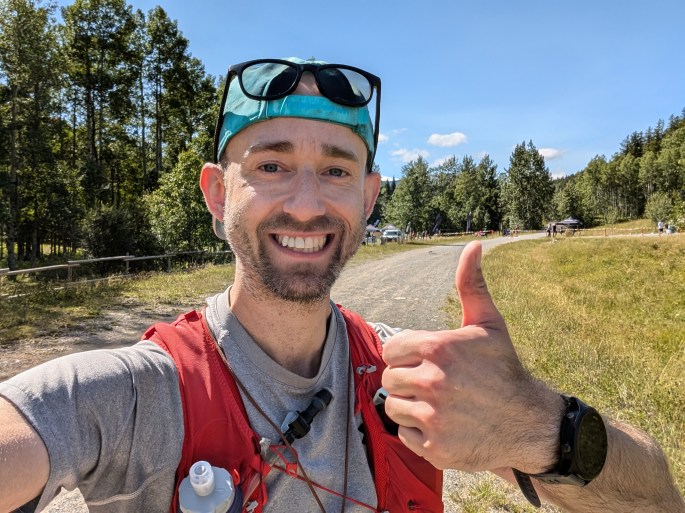
I signed up for the Moose Mountain 42km Trail Race a few weeks before I was going to run the 42km Calgary Marathon in May 2024. I wanted to have the next race in the queue so I didn’t get into an extended recovery mode and become lazy. I wanted my next race to be a trail race and I wanted it to have significant elevation so I could build some muscle on my legs in the next training block. I was looking for something harder than a road marathon and Moose Mountain looked like an excellent choice for entry into the trail running world. It did briefly cross my mind that I could attempt the 50km race, but when I went to register the decision to do 42km was made for me as the longer distance was already sold out.
I had a goal time for the Calgary Marathon of 5 hours and I beat that time by almost 25 minutes. When Coach Halleran saw my splits of the last 10km, I received a text of a devil emoji and messaging that training was about to get harder given how much I exceeded my goal by. I was all for it!
I didn’t exactly have a goal time for Moose Mountain and wasn’t sure how to approach pacing it. My starting point was writing out a pacing plan that allowed me to meet the two cutoffs and that seemed easily achievable. In the end, my game plan for race day was similar to the one I used for Calgary Marathon – conservative in the first 20km, pick it up the next 10km if I feel good, and then go all out the last 12km, all while adapting my pacing to the uphills and downhills. My legs were a bit groggy to start the race but the rest of my body felt good and the legs eventually felt normal around about 5km in. I ended up unintentionally spending most of the first 10km in the general vicinity of the couple people I knew running the 50km race, and that was getting into my head. They had been running for years longer than me and had been getting coached longer than me, so I was constantly wondering if my pace was too fast. I had to bury those thoughts. My effort felt right, and I was following my plan.
After the climb up most of Moose Mountain, I approached the turnaround point at around the 15km mark and felt my left IT band start to get tight. It was annoying but manageable even after the descent down Moose Mountain. I continued running with the annoyance and my effort still felt right, reaching the 27km aid station and still feeling pretty good in general though getting a little tired. I had a drink of Pepsi to try to get a burst of quick energy and hopefully help shake the tiredness and grabbed some snacks and headed out. Within a couple minutes, I hit my rock bottom. My body was out of it, my mind went off the rails, and I could feel the IT band getting tighter. Around the 28km mark, my IT band tightened up in a burst and shot pain through my leg. I was limping, shuffling, skipping, and using my poles as crutches. My brain started questioning everything – “What the hell am I doing here? Why did I sign up for this?” I knew this race was going to be more difficult than the Calgary Marathon and had tried to mentally prepare myself ahead of time for things to go sideways, but this was difficult. I was also having trouble getting food down. I kept pushing, and around 29.5km in I felt like I had made it out of that rock bottom state. My IT band was still causing shooting pains up and down my leg anytime the rolling terrain broke my flow, but mentally and physically in the rest of my body I was doing much better.
The 33km aid station I’m sure was a bit comical for the volunteers. I had no desire to eat anything and was blankly staring at all the snacks in front of me for who knows how long. A volunteer spoke and snapped my mind back to reality when she asked “Umm… maybe you want something salty, like some crackers?”. I couldn’t believe I was so out of it. I had some crackers and ate a piece of banana. I knew I needed to take some other snacks with me because the gels and other sugary fuel in my pack were even less appetizing than the snacks on the table. I filled up my bottles with water and electrolytes, and then set out down the trail – completely forgetting to grab more snacks and I didn’t realize that until a few minutes later. I had to rely on the sugary fuel in my pack that made me want to throw up. I forced that fuel down and found myself at times leaning my head off the trail thinking I was going to see that fuel again. It never did happen, but it certainly wasn’t a fun feeling.
As I ran the last km of the race, the rolling trail levelled out. This gave my IT band some relief and I was able to run all out to the finish line. No one at the finish line knew that only a couple minutes earlier I was using my poles as crutches and moving at a 12:00+ min/km pace.
So that race was fun. And then it wasn’t. And then it was again. And then it really wasn’t, for a long, long time. And then it was again. I finished in 6 hours and 18 minutes, knowing that if my IT band had behaved better that I easily could have been under the 6 hour mark.
I definitely have some takeaways from my first trail race. I’ve had IT issues on and off for quite some time, but getting in more large downhill running would have likely prepared my quads for the beating they took that day. My original training plan included long runs out in the mountains but going through a busy summer with family commitments, a home renovation, and a couple trips to flat ol’ Saskatchewan, I didn’t succeed in getting all of those crucial mountain runs in. I also need to improve my nutrition and aid station game for the next race. Coach Halleran recommended writing out a plan for what to accomplish at each aid station and my time limits at them. I knew her recommending writing it meant it was a critical item, but due to my lack of experience I just couldn’t comprehend it enough because I couldn’t imagine doing anything other than grabbing water and food and getting back on the trail as fast as possible. Having my aid station plans better defined would likely have helped me when my mind was spent at the 33km aid station. Now that I have an idea of what to expect, I’m much better prepared for creating my plan for the next trail race.
Up next? I’m setting my sights on a 50 miler in 2025. I’m not sure which one, but I’m looking forward to taking a month or two off this fall to let my legs recover and then getting back to working hard and seeing what I am able to accomplish in ultra distances.
#LETSKEEPGOING
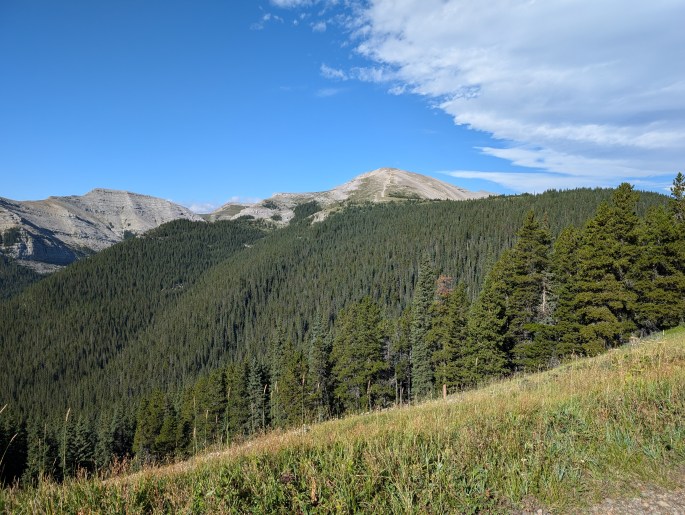
 This one time I went running